
2027: The Year of Business Reinvention Are Nigerian Entrepreneurs Ready for the Next Economic Shift?
- November 24, 2026
- Posted by: enemcons
- Categories:
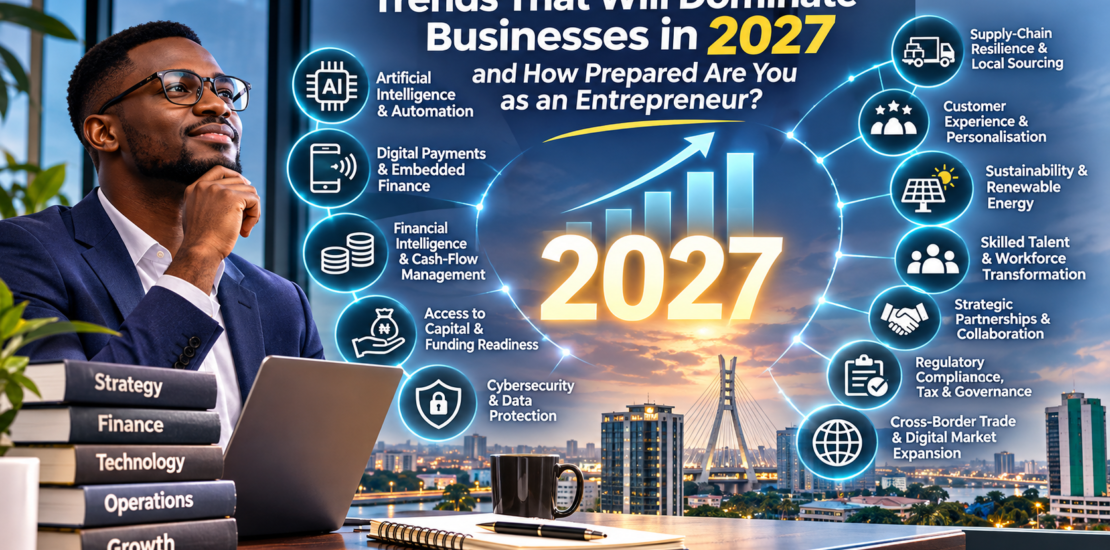
A financial advisor’s perspective on the opportunities, risks and strategic decisions that will determine which businesses grow, survive or disappear in the next business cycle.
Business Strategy | Financial Advisory | Entrepreneurship | 2027 Outlook

Introduction: 2027 Will Reward Prepared Businesses, Not Just Hardworking Entrepreneur
The business environment is changing faster than many entrepreneurs realise. What worked in 2023, 2024 or even 2026 may not necessarily deliver the same results in 2027.
We are entering a business era where technology, artificial intelligence, financial discipline, customer intelligence, access to capital and operational efficiency will increasingly determine competitiveness.
For Nigerian entrepreneurs, the challenge is even more significant. Businesses must navigate inflationary pressures, foreign exchange volatility, high operating costs, changing consumer behaviour, evolving regulatory requirements and increasing competition from technology-enabled businesses.
But within these challenges lies an enormous opportunity.
The entrepreneurs who understand emerging trends early, reposition their businesses and make informed financial decisions will be better positioned to capture new markets, improve profitability and build sustainable enterprises.
The question is no longer simply whether your business is making money today.
The more important question is: Is your business structured, financed and equipped to remain profitable and competitive in 2027?
Let us examine the trends that will shape the business landscape and what entrepreneurs should be doing now to prepare.
1. Artificial Intelligence Will Become a Business Necessity, Not a Luxury
VDIRECK Technologie — IA appliquée pour PME
Artificial Intelligence (AI) will be one of the biggest forces reshaping businesses in 2027. However, the real opportunity will not simply be in adopting AI tools; it will be in using them to improve productivity, reduce costs, increase revenue and make better business decisions.
Businesses will increasingly deploy AI for:
- Customer service, enquiries and automated responses.
- Financial forecasting, budgeting and cash-flow management.
- Sales analysis and customer relationship management.
- Inventory management and demand forecasting.
- Marketing content, advertising and customer segmentation.
- Fraud detection and business risk management.
- Recruitment, employee performance and administrative processes.
We are also moving towards AI agents: systems capable of executing multi-step tasks with limited human intervention.
What does this mean for Nigerian entrepreneurs?
Imagine running a distribution business where your system automatically monitors inventory, identifies fast-moving products, forecasts replenishment requirements and alerts you when a customer is overdue on payment.
Or running a fashion business where AI analyses customer preferences, identifies purchasing patterns and recommends which products to stock.
These are no longer distant possibilities.
How should you prepare?
- Identify at least three repetitive business processes that can be automated.
- Train yourself and your employees to use AI tools effectively.
- Invest in reliable business management software.
- Establish controls around customer data, confidentiality and AI-generated decisions.
- Measure the financial return on every technology investment.
My advice: Do not adopt AI simply because it is fashionable. Adopt it because it solves a business problem and improves your bottom line.
2. Digital Payments and Embedded Finance Will Transform How Businesses Operate
Yilick POS – Empowering African Commerce with AI
The traditional way of receiving and managing business payments is changing. Digital payments, fintech solutions, mobile banking, payment gateways and embedded financial services will become increasingly important.
Customers want convenient payment options, while businesses want faster settlements, better transaction visibility and improved access to financial services.
In 2027, businesses should expect greater integration between:
- Accounting and payment platforms.
- E-commerce platforms and banking services.
- POS systems and inventory management.
- Digital lending and business transaction histories.
- Payment gateways and customer relationship management.
An important development will be embedded finance, where financial services such as payments, credit, insurance and working-capital solutions are integrated directly into non-financial business platforms.
For example, a supermarket distributor may access short-term working capital through its supplier or distribution platform based on verified transaction history.
A retailer may receive financing based on sales turnover rather than relying exclusively on traditional collateral.
For Nigerian SMEs, this presents an opportunity to build stronger financial records and improve their ability to access credit.
How should you prepare?
- Move away from excessive cash-based transactions.
- Adopt reliable digital payment channels.
- Separate personal and business accounts.
- Maintain accurate electronic transaction records.
- Integrate payment solutions with your accounting system.
- Build a credible banking relationship and maintain a healthy transaction history.
A business that cannot demonstrate its revenue, cash flow and transaction history may find it increasingly difficult to attract institutional financing.
3. Financial Intelligence and Cash-Flow Management Will Determine Business Survival
شهادة دورة قصيرة في المحاسبة | دورة مجانية وسريعة
This is one trend I consider particularly important.
Many entrepreneurs confuse revenue with profitability and profitability with cash flow. These are three different financial measures.
A business may generate ₦100 million in annual revenue and still struggle to pay salaries, suppliers, rent and loan obligations.
In 2027, financial discipline will become a major competitive advantage.
Entrepreneurs must move beyond informal bookkeeping and embrace structured financial management.
The businesses that perform better will be those that understand:
- Their cost of doing business.
- Gross profit and net profit margins.
- Working-capital requirements.
- Debtors and creditors management.
- Cash conversion cycles.
- Debt obligations and repayment capacity.
- Monthly cash-flow projections.
- Return on investment (ROI).
Consider a distributor generating ₦50 million monthly in sales. If customers pay after 60 days but suppliers demand payment within 14 days, the business may experience serious liquidity pressure despite recording strong sales.
This is why working-capital management is essential.
How should you prepare?
- Prepare a 12-month business cash-flow forecast.
- Develop monthly management accounts.
- Monitor receivables and outstanding customer invoices.
- Establish a realistic operating budget.
- Avoid borrowing for consumption or expenses that do not generate returns.
- Build an emergency liquidity reserve.
- Understand your business’s break-even point.
My recommendation is simple: Every entrepreneur should know how much money the business needs to survive for the next three months without depending on new sales.
4. Access to Capital Will Become More Strategic: Funding Readiness Will Matter
Koffi Henri Joel Alla – Société Générale Côte d’Ivoire | LinkedIn
Access to finance will remain a critical factor in business expansion. However, the approach to financing is changing.
Banks, development finance institutions, private equity investors, venture capital firms and alternative lenders will increasingly demand stronger evidence of business viability, governance, repayment capacity and financial performance.
Entrepreneurs should become familiar with different funding options, including:
- Commercial bank loans.
- Working-capital facilities.
- Asset financing and equipment leasing.
- Invoice discounting and receivables financing.
- Purchase-order financing.
- Supply-chain and distributor financing.
- Private equity and venture capital.
- Development finance institution funding.
- Strategic partnerships and joint ventures.
For Nigerian businesses, opportunities may also arise from sector-focused financing initiatives in agriculture, manufacturing, renewable energy, healthcare, exports and MSME development.
However, entrepreneurs should not build their financial plans around the assumption that a particular CBN intervention fund or government financing programme will automatically be available. Programme status, eligibility, funding windows and participating institutions must be verified before making investment commitments.
How should you prepare?
Get your business investment-ready.
This means having:
- Properly registered business documentation.
- Up-to-date financial statements.
- Tax and regulatory compliance records.
- A credible business plan.
- Clear ownership and corporate governance structures.
- Evidence of revenue and market demand.
- A realistic financing proposal.
- A clear repayment plan.
One mistake entrepreneurs make is approaching a bank only when they urgently need money.
Build the banking relationship before you need the facility.
5. Cybersecurity, Data Protection and Digital Trust Will Become Business Priorities
The Top Six Cybersecurity Risks Facing Your Small Business
As businesses become increasingly digital, their exposure to cybercrime, fraud, identity theft, phishing attacks and data breaches will also increase.
Cybersecurity will no longer be an issue exclusively for large corporations and financial institutions.
Small businesses are equally vulnerable.
Imagine a business losing access to its customer database, having its bank account compromised or discovering that a fraudulent employee has redirected supplier payments.
The financial consequences can be devastating.
In addition, customers are becoming more conscious of how businesses collect, store and use their personal information.
Entrepreneurs must therefore treat digital trust as an important business asset.
How should you prepare?
- Activate multi-factor authentication on business accounts.
- Use strong passwords and password management tools.
- Restrict access to sensitive financial information.
- Back up critical business records.
- Train employees to identify phishing and fraudulent requests.
- Implement proper approval procedures for payments.
- Understand applicable data protection and privacy obligations.
Remember, technology can accelerate business growth, but poor digital security can destroy years of investment.
6. Supply-Chain Resilience and Local Sourcing Will Become Competitive Advantages
The traditional approach of depending on one supplier, one import market or one distribution channel is becoming increasingly risky.
Global trade uncertainty, geopolitical developments, currency fluctuations, shipping costs and supply disruptions will continue to influence business operations.
For Nigerian entrepreneurs, foreign exchange exposure is particularly important for businesses that depend on imported raw materials, equipment, packaging or finished products.
The ability to source locally, diversify suppliers and manage inventory efficiently will increasingly determine competitiveness.
For example:
- Manufacturers should identify alternative sources of raw materials.
- FMCG distributors should strengthen relationships with multiple suppliers.
- Fashion entrepreneurs should explore local textile and garment production.
- Food businesses should develop relationships with local farmers and processors.
- Retailers should improve inventory planning to reduce stock-outs and excess stock.
There is also a significant opportunity in Nigeria’s agricultural value chains, agro-processing, local manufacturing and distribution networks.
How should you prepare?
- Identify your most critical suppliers.
- Assess your exposure to foreign exchange movements.
- Develop alternative sourcing arrangements.
- Negotiate longer-term supply agreements where commercially sensible.
- Improve inventory monitoring.
- Build stronger relationships across your industry’s value chain.
The businesses that control their supply chains more effectively will have a better chance of protecting margins and maintaining customer confidence.
7. Customer Experience and Personalisation Will Drive Business Growth
Building Customer Trust: A Step-by-Step Approach for Kenyans | DHL Kenya
Customers are becoming more informed, more demanding and less tolerant of poor service.
Price alone will no longer be enough to retain customers. Convenience, trust, speed, service quality and personalised experiences will increasingly influence purchasing decisions.
Businesses will need to understand not just what customers buy but why they buy, when they buy and what makes them return.
Customer experience will become an important differentiator.
Consider two businesses selling the same product at a similar price.
One responds to customer enquiries after two days, has inconsistent delivery and does not follow up after a purchase.
The other provides prompt responses, convenient payment options, reliable delivery and personalised customer engagement.
Which business is more likely to retain its customers?
The answer is obvious.
How should you prepare?
- Build and maintain a customer database.
- Use customer relationship management (CRM) tools.
- Introduce structured customer feedback mechanisms.
- Measure customer retention and repeat purchases.
- Improve complaint resolution.
- Develop loyalty and referral programmes.
- Use customer data responsibly to personalise offerings.
Remember: Acquiring a new customer is important, but retaining an existing customer is often more profitable.
8. Sustainability, Renewable Energy and Energy Efficiency Will Create New Business Opportunities
$700 million! Lagos State, Nigeria plans to install 600MW rooftop PV system–Seetao
Sustainability is moving beyond corporate social responsibility. It is increasingly becoming an operational and financial consideration.
For Nigerian businesses, energy costs remain a significant component of operating expenses. This makes energy efficiency and alternative energy solutions commercially relevant.
In 2027, opportunities will expand around:
- Solar energy installation and distribution.
- Battery storage solutions.
- Energy-efficient manufacturing equipment.
- Waste recycling and management.
- Sustainable packaging.
- Climate-smart agriculture.
- Clean cooking solutions.
- Renewable energy financing.
Businesses that reduce their dependence on expensive and unreliable energy sources may achieve meaningful long-term savings.
There is also an opportunity for entrepreneurs to participate in the growing renewable energy value chain, either as service providers, distributors, installers or financiers.
How should you prepare?
Conduct an energy audit of your business. Determine how much you spend on electricity, diesel and petrol, and assess whether investing in alternative energy can deliver an acceptable payback period.
Do not invest in solar or other energy solutions simply because they are popular. Evaluate the capital cost, maintenance, financing structure, expected savings and payback period.
9. Skilled Talent, Continuous Learning and Workforce Transformation Will Matter More
MicroTech Africa | Tech Skills Training & Scholarships for Africans
The workplace of 2027 will require a combination of technical competence, commercial intelligence, digital literacy and problem-solving skills.
As automation takes over repetitive tasks, employees will need to develop capabilities that complement technology.
Entrepreneurs should expect increasing demand for people with expertise in:
- Data analytics.
- Digital marketing.
- Financial management.
- AI and automation.
- Cybersecurity.
- Customer relationship management.
- Supply-chain management.
- Business development and strategic sales.
But technology alone will not create successful businesses. Leadership, negotiation, creativity, communication and relationship management will remain valuable.
How should you prepare?
Invest in your employees, not just your equipment.
Develop a structured training programme, establish measurable performance indicators and ensure employees understand how their responsibilities contribute to business profitability.
Entrepreneurs must also invest in their own knowledge. The business owner who stops learning risks becoming the biggest limitation to business growth.
10. Strategic Partnerships, Business Collaboration and Value-Chain Financing Will Accelerate Growth
The idea that every business must grow independently is becoming increasingly outdated.
In 2027, strategic partnerships will become an important route to market expansion, access to capital, technology adoption and customer acquisition.
Businesses will increasingly collaborate with:
- Banks and financial institutions.
- Fintech companies.
- Technology providers.
- Manufacturers and distributors.
- Logistics companies.
- Government agencies.
- Development finance institutions.
- International investors.
Consider a manufacturing company with a strong product but limited distribution capacity. Rather than building an expensive distribution network from scratch, it can partner with established distributors and provide structured financing to support product distribution.
Similarly, a fintech company can partner with a bank to access financial infrastructure, while the bank benefits from new customers, transaction volumes and additional revenue streams.
This is the value-chain approach to business growth: identifying the ecosystem around a product or service and building relationships that allow participants to benefit commercially.
How should you prepare?
Stop looking at your competitors and industry participants only as rivals. Identify opportunities for collaboration, joint marketing, shared infrastructure, distribution agreements and mutually beneficial financing arrangements.
The right partnership can deliver growth that would take years to achieve independently.
11. Regulatory Compliance, Tax Governance and Corporate Governance Will Become Non-Negotiable
Nigeria Income Tax Guide 2026 | Bands, Reliefs and PAYE Explained
One area entrepreneurs often underestimate is regulatory compliance.
As businesses grow, regulatory obligations become more complex. Tax administration, business registration, employment obligations, industry-specific licences, data protection and financial reporting will increasingly influence business sustainability.
In Nigeria, entrepreneurs must pay particular attention to evolving tax reforms and the requirements applicable to their business structures and sectors.
A business that operates without proper documentation may encounter difficulties when seeking financing, attracting investors, entering into corporate contracts or expanding into new markets.
Corporate governance is equally important.
Many Nigerian businesses remain heavily dependent on their founders. Financial decisions, procurement, recruitment, sales and even routine approvals are concentrated in one individual.
This may work when the business is small, but it becomes a serious obstacle as the organisation expands.
How should you prepare?
- Review your company’s registration and statutory documentation.
- Maintain proper accounting and tax records.
- Understand the tax obligations applicable to your business.
- Separate personal and business finances.
- Introduce clear financial approval limits.
- Document operational processes.
- Establish appropriate internal controls.
- Develop a succession and business continuity plan.
A properly structured business is easier to finance, manage, scale and eventually transfer or sell.
12. Cross-Border Trade and Digital Market Expansion Will Create New Revenue Opportunities
How to Become an Importer in Ghana: 7 Essential Steps – XpliteGH Importation
Technology is reducing some of the traditional barriers to reaching international customers.
Nigerian businesses can increasingly use digital platforms, international payment solutions, e-commerce marketplaces and strategic distribution partnerships to access customers beyond their immediate geographical markets.
The African Continental Free Trade Area (AfCFTA) also provides a framework for expanding intra-African trade, subject to applicable rules of origin, customs requirements and market-access arrangements.
Potential opportunities include:
- Agricultural exports and processed foods.
- Fashion, beauty and cosmetics.
- Creative content and entertainment.
- Professional and consulting services.
- Software and technology solutions.
- Business process outsourcing.
- Educational and digital services.
However, international expansion requires more than identifying customers abroad.
Entrepreneurs must understand foreign exchange exposure, export documentation, product standards, logistics, payment settlement, customs requirements and the regulatory environment in destination markets.
How should you prepare?
Start by identifying one viable export market. Research its customer demand, pricing, competition and regulatory requirements. Develop a market-entry plan before committing substantial capital.
Think beyond selling within your immediate community. Your next customer could be in another African country or a completely different continent.
What These Trends Mean for Nigerian Entrepreneurs
The opportunities are significant, but preparation must be deliberate.
Nigeria’s economic outlook provides reasons for cautious optimism. The IMF’s 2026 Article IV assessment projects real GDP growth of 4.3% for 2027, although businesses should recognise that macroeconomic growth does not automatically translate into improved profitability for every enterprise. imf.org+1
The digital economy, telecommunications, fintech and technology-enabled services are among the areas expected to contribute to economic expansion. Deloitte Insights
There is also encouraging evidence from the SME sector. Mastercard’s June 2026 SME Confidence Index reported that 81% of surveyed Nigerian SMEs were confident about the year ahead, while 69% were seeking credit to support growth. The survey also highlighted digitalisation and staff development as major priorities. Mastercard Newsroom
The implication is clear: entrepreneurs need to combine optimism with proper financial planning, technology adoption and operational discipline.
The 2027 Entrepreneur Readiness Framework: Ten Questions You Must Answer
Before entering 2027, I encourage every entrepreneur to conduct an honest assessment of their business.
Ask yourself the following questions:
1. Financial management: Do I have reliable financial statements and a cash-flow forecast for the next 12 months?
2. Technology: Have I identified areas where AI and automation can reduce costs and improve productivity?
3. Funding: Is my business investment-ready, with proper financial records and a credible business plan?
4. Customers: Do I have a reliable customer database and a strategy for retaining existing customers?
5. Profitability: Do I know my actual profit margins, operating costs and break-even point?
6. Market positioning: Do I have a clear competitive advantage over businesses offering similar products or services?
7. People: Are my employees equipped with the skills required to compete in 2027?
8. Risk management: Do I have adequate controls against fraud, cybercrime, operational disruptions and financial losses?
9. Growth strategy: Have I identified new markets, products, services or strategic partnerships that can increase revenue?
10. Governance: Can my business operate effectively without my personal involvement in every transaction and decision?
If you answered NO to more than three questions, your business may need significant restructuring and repositioning before 2027.
Your 90-Day Business Preparation Plan for 2027
Knowing the trends is not enough. The real value lies in translating them into actionable business decisions.
I recommend a 90-day preparation programme.
Days 1–30
Phase 1: Business Health Check
- Conduct a financial and operational review.
- Analyse revenue, costs, profit margins and cash flow.
- Review outstanding loans and customer receivables.
- Identify your three biggest business risks.
- Assess your competitive position.
Days 31–60
Phase 2: Business Transformation
- Identify practical AI and automation opportunities.
- Review your products, pricing and customer segments.
- Strengthen digital payment and accounting systems.
- Train employees in critical business skills.
- Identify funding and strategic partnership opportunities.
Days 61–90
Phase 3: Growth and Execution
- Finalise your 2027 business plan and budget.
- Establish monthly financial and operational targets.
- Prepare an investment or financing proposal if required.
- Launch at least one new growth initiative.
- Establish a monthly performance review process.
The Financial Advisor’s Final Word: Don’t Just Enter 2027, Position Your Business for It
One of the biggest mistakes entrepreneurs make is waiting until they experience a business challenge before taking corrective action.
They wait until cash flow becomes difficult before approaching their bank. They wait until competitors take their customers before investing in technology. They wait until their operating costs become unsustainable before reviewing their business model.
Successful entrepreneurship requires anticipation, not just reaction.
The next phase of business competition will favour entrepreneurs who understand their numbers, embrace technology, manage risks, invest in people, build strategic partnerships and maintain access to capital.
I also want entrepreneurs to appreciate that business growth is not necessarily about having more branches, employing more people or generating higher turnover.
Real business growth is about building an enterprise that generates sustainable profits, maintains healthy cash flow, creates value for customers and can operate without being entirely dependent on its founder.
As we approach 2027, do not simply ask how much revenue you want to generate.
Ask yourself:
- How profitable will my business be?
- How efficiently will I operate?
- How will I finance my growth?
- What value will I offer that competitors cannot easily replicate?
- How prepared am I for the risks ahead?
The opportunities will be available. The real difference will be in who is prepared to take advantage of them.
2027 will not necessarily be the year of the biggest businesses. It could be the year of the most innovative, financially disciplined and strategically prepared businesses.
The question remains:
How prepared are YOU?
About the Author
Ladi Ene Garba
Managing Partner / Principal Consultant, Enem Consulting
Ladi Ene Garba is a financial and business advisory professional with over 21 years of experience in the banking and financial services industry. Her experience spans commercial banking, financial advisory, business restructuring, fundraising, strategic planning, SME development and financial literacy.
Through Enem Consulting, she works with businesses and entrepreneurs to improve financial performance, strengthen business structures, access funding, manage risks and develop sustainable growth strategies.
Her philosophy is that business success is not just about having a great idea; it is about having the financial intelligence, structure, discipline and strategy to turn that idea into a sustainable enterprise.
Sources and further reading
The analysis above draws on recent business and economic outlooks, including:
- IMF – Nigeria 2026 Article IV Consultation and 2027 Economic Projections.
- Mastercard – Nigerian SME Confidence Index, June 2026.
- Gartner – Strategic Predictions for 2027.
- Omdia – Technology Forces Shaping 2027.
- Deloitte – West Africa Economic Outlook.
.